Capturing Value From Every Drop: Reflecting On The Drainage Water Recycling Economic Analysis Report
When we first agreed to partner with the Environmental Defense Fund on the Economic Analysis of Drainage Water Recycling: Opportunities for Supporting Farm Resilience and Water Quality report, we knew we were stepping into uncharted territory. While the concept of recycling drainage water is not new, understanding its true economic potential for producers and what it means for conservationists and downstream communities was a gap waiting to be filled by ISG’s expertise, informed by years of on-the-ground experience with agricultural water management.
This analysis gave us the chance to bring together engineering, economics, and environmental science to tell a complete story about what drainage water recycling can deliver for agricultural water management. Now that the report is complete, we wanted to share a few personal reflections on what we learned and where we think the practice is headed.
The Value of Active Storage
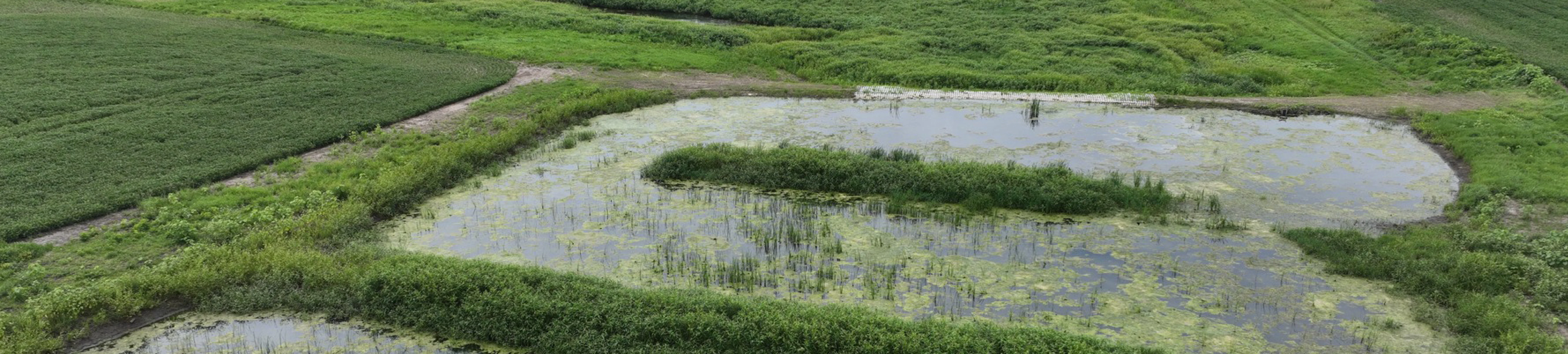
One of the biggest takeaways from the research was the clear value of active storage. Designing systems that capture, store, and intentionally reuse drainage water can dramatically maximize water quality and water availability benefits. Active storage allows producers to better control when and how water is used for irrigation during dry spells and dramatically increases water quality benefits.
When storage is thoughtfully located, particularly along existing waterways and shared among multiple farms, the return on investment improves significantly. It is a win-win approach: improved yields and operational costs for producers and stronger environmental outcomes for communities downstream.
Successful Siting + Irrigation Selection
As with most engineering solutions, success lies in the details. Proper siting and irrigation method selection are critical to maximize returns. Every field, soil type, and watershed behaves differently, and tailoring drainage water recycling to those conditions is essential.
Our work found that properly siting the design of the system is one of the most important indicators of economic success. Well-sited and designed sites will maximize benefits and create positive outcomes, while poorly sited and designed sites may not be economically feasible. Through our custom model site analysis, we found integrated drainage and irrigation improvements can result in 8%–15% increases in yields, or $300 to $500 per acre. Those are significant numbers, especially when paired with up to $40,277 in annual added benefits to downstream communities from nitrogen reduction.
Why Public Support Matters
One thing we cannot stress enough: the future success of drainage water recycling depends on public investment. The systems come with substantial upfront costs, typically between $1.8 million and $3.3 million. While the returns are strong, achieving widespread adoption will require shared responsibility. Our work shows that drainage water recycling is worth the public investment—water quality benefit value is comparable to other more widely accepted agricultural best management practices.
Public funding for storage design, development, and construction, alongside drainage district and landowner investment in field drainage and irrigation, creates a balanced and sustainable investment. When everyone has skin in the game, the benefits extend far beyond the individual farm: cleaner water, flood mitigation, and more resilient agricultural communities.
ISG can help partners navigate and secure these critical public funding opportunities, getting projects off the ground and aligning financial support with local and regional priorities. Without that public buy-in, many projects will not move forward. With it, however, drainage water recycling could become a linchpin of next-generation water management across the Midwest.
Balancing Agriculture + Conservation
Perhaps most exciting is how this practice bridges agricultural and conservation goals. It is not often that a single approach benefits producers and water quality, but drainage water recycling does exactly that.
As engineers, we see drainage water recycling as an opportunity to redefine how we think about water management, shifting from drain and release to capture and reuse. And as members of the broader drainage industry, we are encouraged to see how partnerships like this one—between the Environmental Defense Fund, ISG, and Hay Water Solutions—can bring the science, design, and economics together to move the industry forward.
There is still work to be done. Continued research, demonstration projects, and long-term monitoring will be key to refining designs and documenting outcomes. However, with the right mix of innovation, investment, and collaboration, drainage water recycling could play a defining role in building resilient, sustainable agricultural systems for decades to come.
“This is very well done and perfectly timed report that will serve as a valuable resource for conservation planning and drainage water recycling implementation in Ohio and many other states,” said Dr. Vinayak Shedekar of The Ohio State University. “I am confident that these resources will be utilized heavily across the region.”

.webp)
.webp)
.webp)
.webp)

Related Articles







Community Development Plans: Strengthening the Foundation for Deeper Connections
For a community to evolve into a quality place to live, work, and explore, it starts with a vision. ISG's Planning Group helps bring visions to reality through a strategic process that results in an actionable, and holistic plan, also known as a Community Development Plan (Plan).