4 Benefits of Professional Facility Assessments
When a critical building system experiences operational issues, facility staff are often the first to be called. They know the building inside and out, understand the daily operations, and keep your systems running. A facility assessment serves a different purpose. Rather than focusing on today’s repairs, it provides a comprehensive understanding of building conditions, future needs, risks, and investment opportunities.
After more than five years of conducting assessments of facilities ranging from fire and police departments, libraries and public works buildings, to city halls, I have found there are four primary benefits to hiring a professional assessment team.
1. Long-Term Perspective
A maintenance professional and a facility assessment expert often view the same systems differently, as each evaluates conditions through a distinct lens and for a different purpose. For example, if occupant comfort is frequently interrupted with fluctuating temperatures, a facilities expert may be able to identify that the systems that control the temperature are at the end of their remaining useful life which is reducing efficiency and running the risk of a more costly failure in the future.
Remaining useful life is one of the items you will see in our assessment report. We prioritize your whole building’s site and systems for next-step recommendations. Reports are organized in an easy-to-use format with existing condition categories with detailed descriptions, recommendations, and estimated costs.
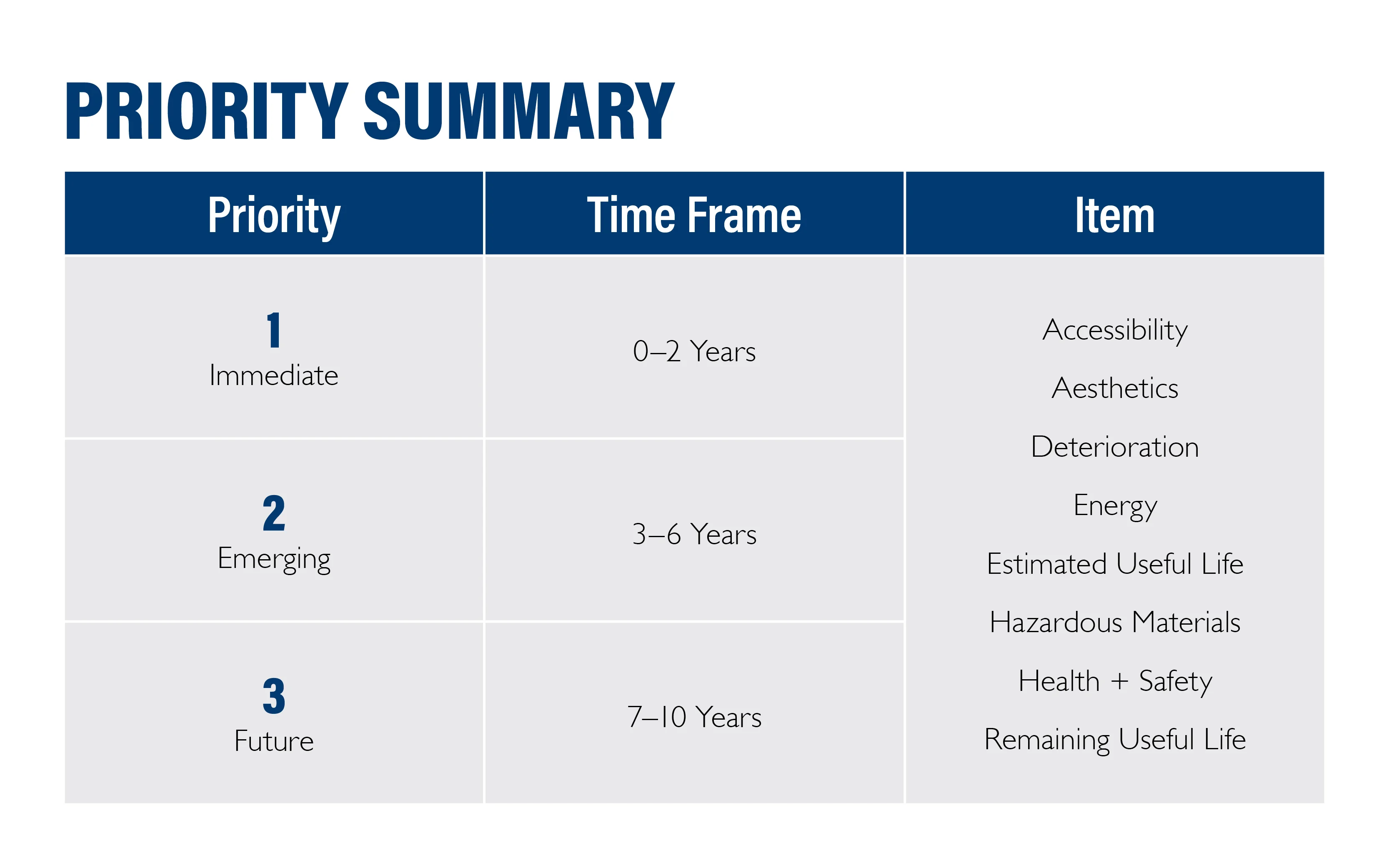
In addition to these items, we assess your facility’s compliance such as accessibility to meet the American with Disabilities Act (ADA) requirements, as well as codes for fire safety systems and life safety equipment to make sure your building remains a safe place for occupants.
Using the findings from our assessment, we will guide you through options for planning, budgeting, and building a timeframe for repairs, replacements, or new construction; and we help align them with your organization’s goals.
2. Fresh Eyes on Familiar Spaces
When you see a building day in and day out, certain conditions can become easily overlooked. You may have aging finishes, equipment failures, accessibility issues, or persistent comfort complaints from occupants in certain zones. This is often referred to in the industry as facility blur. While in-house staff have a deep understanding of the building operations, as third-party assessment professionals, we have the benefit of bringing a fresh viewpoint that can quickly identify potential hazards, repairs, or code issues previously overlooked or ineffective repairs that reduce operational efficiencies.
3. Underlying Risks
Small issues often develop gradually and may not disrupt day-to-day operations until they become expensive repairs or operational challenges. By assessing the condition of your facilities, experts identify areas where improvements can improve operations and efficiencies, protect long-term performance, enhance accessibility, and strengthen safety systems. When you hire us to perform your facility assessment, you know our priority is the safety and wellbeing of the people who your facilities serve.
Hiring ISG to perform your facilities assessment mitigates potential safety risks for your maintenance, staff, and building users and provides an understanding of where capital investments, repairs, or system improvements will have the greatest impact. We identify immediate, emerging, and future needs of your facilities, so critical systems stay operational.
Our hands-on site visits are supported by technology to provide you with a comprehensive analysis of your building’s systems.
3D Scanning
Our 3D scanning and thermal imaging cameras help to supplement technical observations of existing conditions. These scans do more than just safely scan buildings—the team takes high-resolution 3D documentation and incorporates it into critical design software to validate the technical field observations or to identify any structural abnormalities. This helps our team:
- Capture complete digital files of inaccessible or undocumented building conditions
- Retrieve data from restricted, unsafe, or hard-to-reach areas
- Eliminate the need for future site visits
- Bypass ladder/lift use and work near hazardous areas
- Reduce human error with hyper-detailed, multi-angled data
.webp)
Pipe Crawler
Sub-surface utilities and other hard-to-access areas are supported by our pipe crawling survey capabilities. This equipment allows our team to access stormwater, process, and underground piping systems when it is required. The pipe crawler is designed to:
- Identify and measure critical project elements without excavation or human entry
- Provide live diagnostics and video capture with laser measurement precision
- Accurately measure pipe joints, slope, and overall pipe condition
- Provide accuracy and detail not available with traditional manual surveying
- Eliminate the need for confined space entry or hazardous work conditions
4. Data-Driven Reporting for Better Decisions
When opinions vary on the conditions of the building’s infrastructure, it can be difficult to determine the right course of action. A professional assessment applies a consistent methodology and evaluation criteria, so decisions are based on documented conditions rather than individual opinions. Our process has a controlled outcome based on codes, standards, and data, all of which help guide cost-efficient decisions.
Our multidisciplinary team performs assessments using a collaborative approach that includes mechanical, structural, and electrical engineers, as well as other facility experts. While each ISG professional reviews specific attributes applicable to their professional specialty, we will work together to provide a comprehensive report. We document equipment, assess existing conditions, compare findings to code requirements, and communicate findings and recommendations clearly with useful tools such as dashboards for tracking and monitoring the recommended improvements after the report is delivered.
ISG’s process is clear, reliable, and thorough to ensure you are getting the best service possible.
.webp)
A facility assessment is more than a building walkthrough. It provides the information needed to understand existing conditions, identify priorities, reduce uncertainty, and make informed decisions about future investments. Whether you’re evaluating a single facility or an entire portfolio, having accurate, objective information helps you move forward with confidence.
We look beyond whether systems are working today and assess their ability to support the facility’s mission for years to come.
“The facilities assessments have helped the Clay County Board of Supervisors make informed decisions on budgeting and prioritizing maintenance needs of Clay County buildings.” – Ann Baschke, Clay County Auditor
Planning for a Facility Assessment?
Get a professional assessment from ISG for objective insights, long-term planning information, risk identification, and standardized data.
Connect with me, Thad Dahling, at Thad.Dahling@ISGInc.com, or with our team at Info@ISGInc.com, to learn more about facilities assessments, planning, and ISG.

Related Articles





Community Development Plans: Strengthening the Foundation for Deeper Connections
For a community to evolve into a quality place to live, work, and explore, it starts with a vision. ISG's Planning Group helps bring visions to reality through a strategic process that results in an actionable, and holistic plan, also known as a Community Development Plan (Plan).