CMAR Insights: Clearing Misconceptions + Clarifying Benefits
Despite its growing popularity, misconceptions about Construction Manager at Risk (CMAR) delivery still exist. Many assume it primarily benefits contractors, but the reality is far different. CMAR is designed to foster collaboration and prioritize transparency among owners, designers, and contractors, creating a win-win environment for all stakeholders.
Benefits for Each Stakeholder
Owners
- Pre-bid predictability through a Guaranteed Maximum Price (GMP)
- Reduced financial risk
- Schedule certainty
- Gain a trusted advocate who helps align design decisions with budget and schedule goals
Design Teams
- Constructability reviews during design to avoid conflicts later
- Streamlined communication with the contractor for faster decision-making
- Opportunity to integrate value engineering without compromising design intent
Contractors
- Have clear roles and responsibilities, reducing adversarial relationships
- Influence design for efficiency and cost savings
- Chance to build trust and long-term partnerships earlier in the project
Process
STEP 1
Notice of Intent
Public owner posts notice of intent to required locations, making the public aware of the intent to enter a GMP contract for said project.
STEP 2
Request for Qualifications (RFQ)
Interested Construction Managers (CMs) submit credentials, past project performance, and project approach.
STEP 3
Shortlisting + Request for Proposals (RFP)
Qualified CMs are invited to submit detailed proposals on preconstruction plan, fee structure, schedule, and approach to cost control.
STEP 4
Evaluation + Interviews
Qualifying CMs are interviewed at the owner’s discretion. Selection is based on qualifications, proposed fees, schedule, and a CM’s overall ability to deliver value to the project. Selecting the lowest fee is not required, which is a critical difference from design-bid-build structures.
STEP 5
Preconstruction Agreement
The CM and the owner enter a preconstruction agreement. The CM supports design during cost estimation, value engineering, and constructability reviews.
STEP 6
Guaranteed Maximum Price Negotiation
Once design reaches an agreed upon milestone (e.g. 60, 90%), the CM proposes a GMP. If accepted, the CM assumes the financial risk for delivering the project at that price.
STEP 7
Bidding
In most states, the CM must prequalify all prime bidders wanting to bid on the project. This process may vary by CM and public entity and should include assessment of credentials, past performance, and capacity. Only those deemed qualified can submit a bid for any portion of the project.
STEP 8
Construction
CM manages construction and ensures GMP and schedule compliance.
“CMAR creates win-win outcomes by bringing the contractor’s constructability, schedule, and cost insights into the design process. That collaboration, paired with full cost transparency, allows owners to make informed decisions, balance project priorities, and deliver stronger, more predictable outcomes.” – Sherri Leonard, Director of Collaborative Delivery for Rice Lake Construction
Real-World Example
.webp)
Water Resource Recovery Facility | Hartford, SD
The Hartford Water Resource Recovery Facility project illustrates CMAR strengths in action. By involving the CM early, the team identified cost-saving opportunities without sacrificing quality or schedule. This collaborative approach resulted in zero change orders and returned nearly 50% of contingency funds back to the owner; a powerful demonstration of the value CMAR can deliver.
“The City first utilized the CMAR process when we erected our new wastewater treatment facility. Collaboration and planning with our engineer and CMAR right from the start of the project helped make it go well.” – Teresa Sidel, City Administrator of City of Hartford, SD
How to Choose the Right Delivery Model
Factors such as project size, schedule constraints, state regulations, and project priorities should guide the decision. Work closely with your trusted design partners to select the model that aligns with your goals.
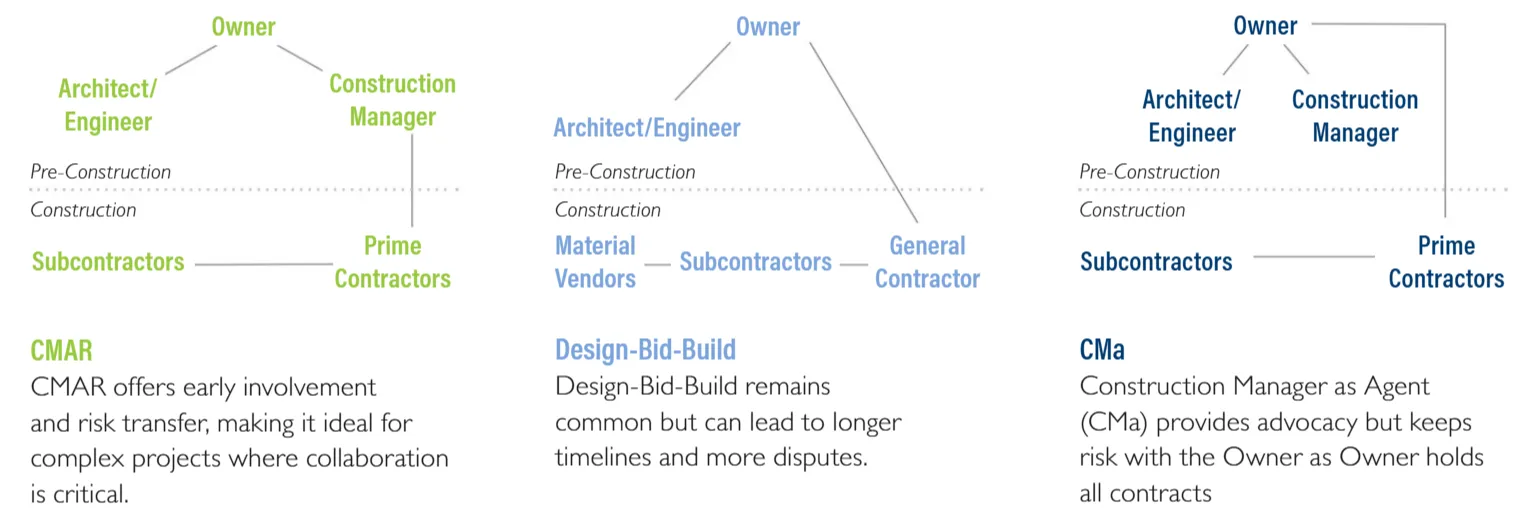
This story was originally featured in our Volume 1, Issue 3 Municipal Matters newsletter. View the full newsletter here.
Blog Authors

Senior Project Manager
Erik.Pingel@ISGInc.com
515.243.9143

Civil Engineer
Arie.Hoekstra@ISGInc.com
605.274.6401