IDALS Sioux County Aquifer-Recharging Wetland Complex

IDALS Sioux County Aquifer-Recharging Wetland Complex
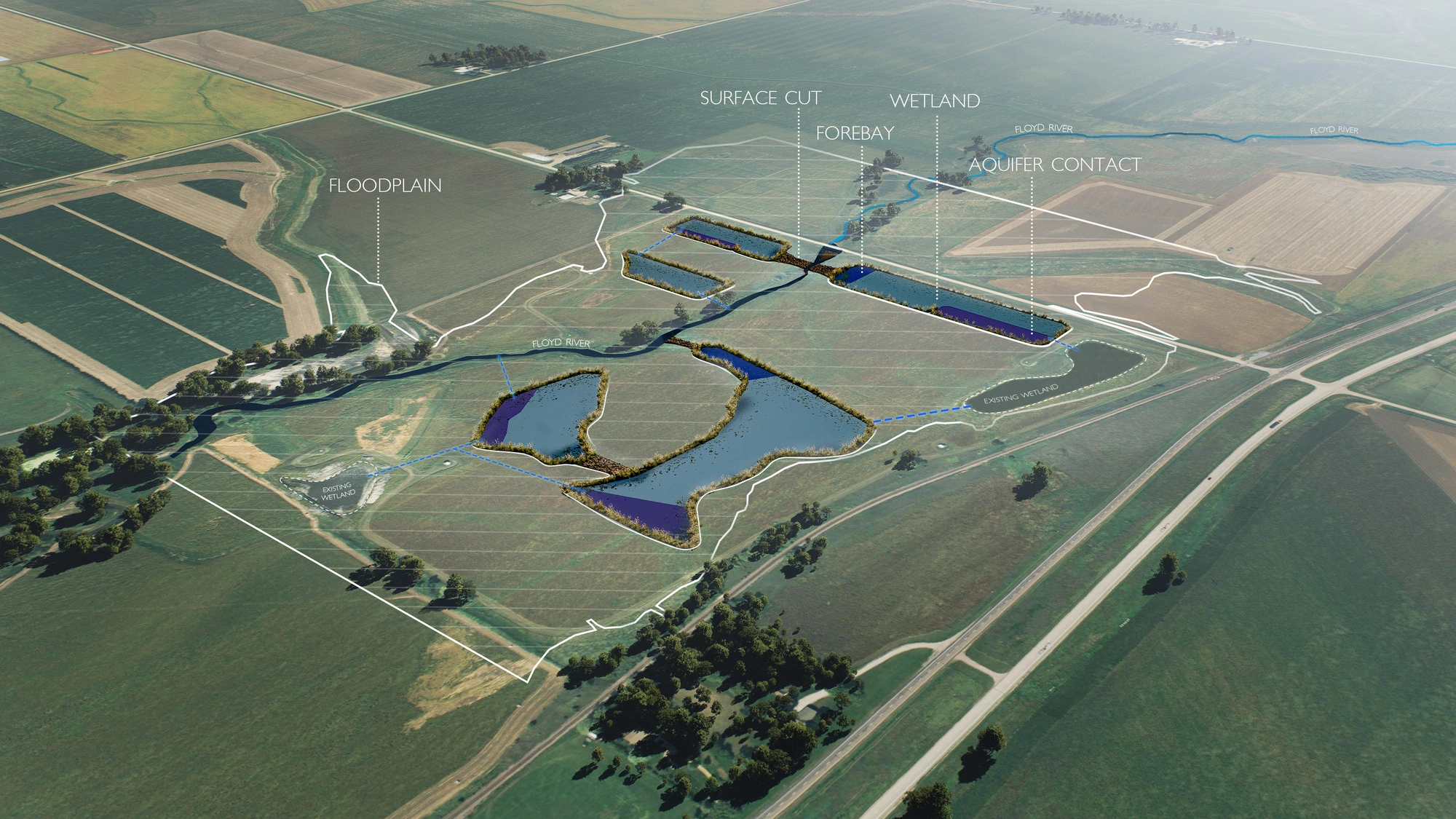
The Iowa Department of Agriculture and Land Stewardship (IDALS) partnered with ISG to develop an innovative aquifer-recharging wetland complex to benefit Rural Water System #1 (RWS #1) in northwest Iowa to improve water quality, reduce water treatment needs, and provide a scalable model for drought and climate resilient rural water management in similar shallow-aquifer regions. RWS #1 has 1,375 service connections and provides drinking water service to over 3,175 customers that include residents, commercial properties, and agricultural enterprises the drive the local economy in rural Sioux County, Iowa. The project site, located within a floodplain and over a shallow aquifer, was an ideal location for a nature-based water quality solution. The system directs floodwater and surface flow from the Floyd River into a sediment forebay, followed by a constructed wetland complex that reduces turbidity and removes nutrients. Water then moves into a designated aquifer contact zone, where natural infiltration occurs. Sedimentation, plant uptake, and microbial activity help reduce nitrate concentrations before the water reaches nearby wells.
This approach lowers treatment requirements for the rural water system, reduces operating costs, and provides cleaner, more reliable drinking water to the surrounding communities. The nature-based solution also enhances floodplain functions and increases ecological benefits of the riverine and wetland complex.
The permitting process required coordination with the Iowa Department of Natural Resources (DNR) and U.S. Army Corps of Engineers (USACE), and incorporated a no-rise analysis using HEC-RAS to ensure the project would not impact base flood elevations. These informed a design that functions effectively within floodplain constraints while promoting the wetland complex, serving as a rare instance of aquifer recharging wetlands in Iowa and integrating nature-based solutions within a regulated floodplain.
- 20.5 combined acres
- Five constructed wetlands in connected floodplain complex
- Four Floyd River-adjacent counties experiencing improved water quality
- Nature-based design for improving rural drinking water source climate resilience, quality, and availability
- Site design, construction administration, LiDAR-based drone surveys, hydraulic modeling, and floodplain permitting provided


Applied Tech
